Ultrasonic Non Destructive Testing Equipment: Revolutionizing Quality Control Checks

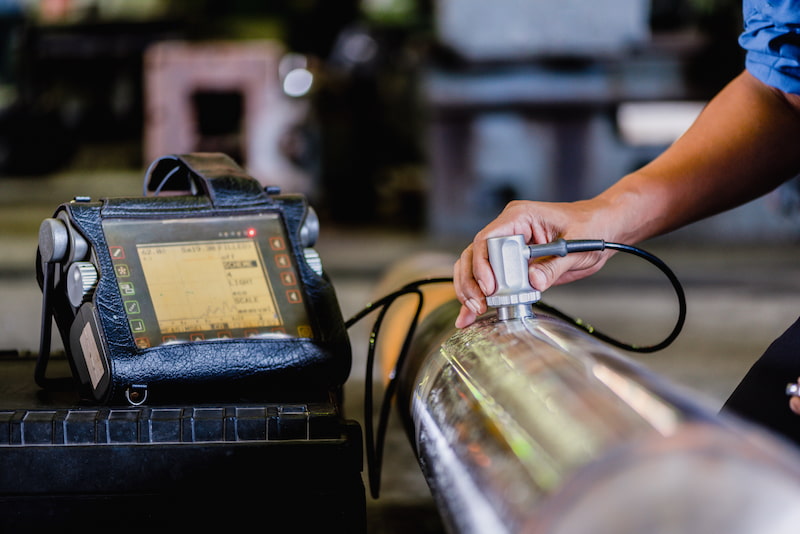
Non-destructive testing (NDT) has evolved by leaps and bounds over the past few decades. Ultrasonic NDT equipment in particular has become a game changer for industries where quality control and material integrity checks are crucial.
What is Ultrasonic NDT?
Ultrasonic NDT utilizes high-frequency sound waves to examine materials and components to evaluate properties such as flaws or cracks without damaging the part itself. In ultrasonic testing, a transducer attached to a probe sends pulsed ultrasonic sound waves into the material. When the wave hits an imperfection or change in material properties it sends back an echo. By analyzing the amplitude, time of flight and other properties of this echo, technicians can determine critical information without needing any sample preparation or part damage.
The key advantages of ultrasonic NDT are that it can detect both surface and internal defects in materials, provide high resolution detection, and be used on a wide variety of materials from metals to composites to ceramics. Having such a versatile and high-resolution method of non-destructive testing is crucial for industries dealing with mission critical components that can't be damaged through traditional testing means.
Industrial Applications
Power Generation
Ultrasonic Non-Destructive Testing Equipment is essential for power plants, where cracks or defects in steam pipes, turbine blades or other components could lead to catastrophic failures. Regular ultrasonic scans help detect flaws at an early stage to minimize risks and downtime for maintenance and repairs. The technology is also crucial for quality assurance of welding seams during new component manufacturing.
Aerospace
In the aerospace sector, ultrasonic testing plays a key role in quality control for aircraft parts production as well as scheduled maintenance checks of airframes and engines. Even tiny defects found could save lives, so NDT testing ensures the highest safety standards are met without weakening structural integrity. Composite and bond testing is another specialized use in this industry.
Energy & Oil and Gas
Checking pipeline welds, pressure vessels, storage tanks and other process equipment for integrity issues non-destructively is extremely important in the energy sector. Underwaterinspections using special transducer probes also let users test offshore structures, risers and subsea components that can’t be easily accessed otherwise.
Manufacturing
From automotive to industrial machinery to electronics, manufacturers rely on ultrasonic NDT equipment to conduct 100% inspection of critical components. It provides an effective way to both troubleshoot production quality problems and ensure outgoing parts meet the most stringent specifications. The technology supports lean manufacturing by catching issues early.
New Developments in Ultrasonic NDT Equipment
Advancements in transducer technology have improved detection capabilities significantly. Array transducers with higher element counts provide improved resolution. New automated systems streamline testing workflows. Dual element transducers enhance sensitivity for composites. Plus-minus beamforming helps locate defects. And phased array systems are gaining popularity due to faster inspection rates.
New generation ultrasonic flaw detectors also offer more advanced data analysis options. Digital communications enable remote testing and wireless capabilities. Software driven units offer standardization across testers. Pulse-echo and through-transmission testing options address diverse material requirements. Structural health monitoring solutions leverage portable UT hardware.
With demand growing for precision ultrasonic scans of additive manufactured parts, equipment manufacturers are designing solutions to suit those complex geometries as well. Even non-contact air-coupled transducers address inspection challenges on difficult to reach areas or moving components. Clearly, the scope of NDT technology is widening continually.
Future Potential
It's estimated that almost 80% of manufactured goods undergo some level of ultrasonic NDT currently. With quality expectations rising in all industries, that adoption rate is projected to increase even further in the future. Ongoing research promises more improvements too including phased arrays for 3D volumetric imaging, high temperature transducer variants, guided wave innovations, and sensor network technologies for big data analysis of structural health.
Get More Insights on this Topic- https://www.marketwebjournal.com/ultrasonic-testing-is-one-of-the-most-commonly-used-and-widely-applied-non-destructive-testing-methods