Reducing Solar Component Cost Augmenting Solar Street Lighting Market Growth
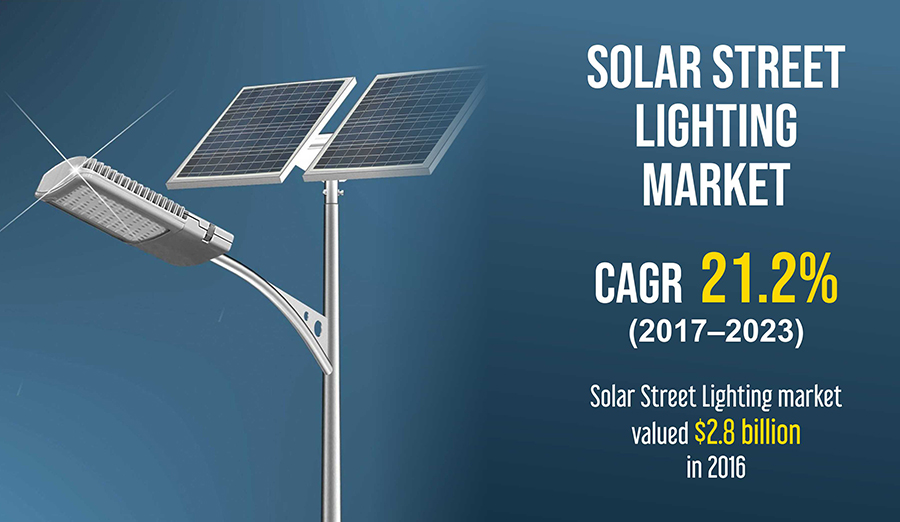
The emergence of smart city projects, governments’ stringent regulations and support, and decreasing solar component costs are some of the factors playing a significant role in the growth of the solar street lighting market. In 2016, the market generated a revenue of $2.8 billion, and it is predicted to attain a size of more than $10.8 billion, progressing at a CAGR of 21.2% during 2017–2023 (forecast period).
Solar street lights are charged through photovoltaic (PV) panels installed at the top of the lighting structure or integrated into the pole.
On the basis of product type, the solar street lighting market is bifurcated into on-grid and standalone solutions. Of these, during the historical period (2013–2016), the standalone bifurcation dominated the market in terms of revenue, and it is predicted to maintain its lead during the forecast period as well.
Standalone lights do not need any external power supply, which makes them a preferred product for street lighting. Standalone solar street lights provide electricity to areas with no access to transmission grids and lines.
Hence, various governments’ support and regulations, reducing solar component cost, and rapid emergence of smart cities are expected to augment the market growth during the forecast period.