Industrial Lubricants Market to Display Healthy Growth in 2016–2024

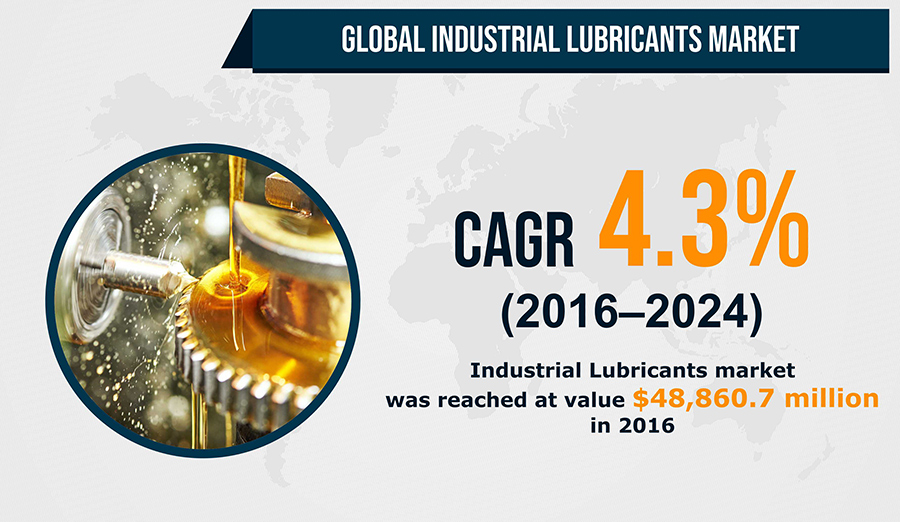
The increasing usage of industrial lubricants in textile, chemical manufacturing, and metal working industries is driving the global industrial lubricants market growth. The market generated a revenue of $48,860.7 million in 2016, and is expected to advance at a CAGR of 4.3% during the forecast period (2016–2024). Industrial lubricants such as oil, grease, and fluids are used in machinery components to protect them from wear and tear and lessen friction and binding. In some cases, they are used to reduce the electricity resistivity and escalate thermal conductivity at the same time.
Research Background
- Research Objectives
- Market Definition
- Research Scope
- Market Segmentation by Product
- Market Segmentation by Application
- Market Segmentation by Geography
- Analysis Period
- Market Data Reporting Unit
- Value
These oils are used as a processing aid or as a raw material in multiple end-use industries, such as chemicals, plastic, and rubber. These lubricants are witnessing huge demand in the Asia-Pacific (APAC) region due to the expanding chemical industry, which is expected to boost the market. Industrial lubricants find wide-ranging applications in industries including metalworking, energy, chemical manufacturing, textile, food processing, hydraulic machinery. Among these, in 2016, the chemical manufacturing industry held the largest (over 20.0% sales volume share) in the industrial lubricants market and would continue dominating it during the forecast period.
Global Market Size and Forecast
5.1 By Product
5.2 By Application
5.2.1 Metalworking by Type
5.2.1.1 Metal forming by metal type
5.2.1.2 Metal cutting by metal type
5.2.1.3 Metal joining by type
5.2.2 Textile by Type
5.2.2.1 Textile finishing by type
5.2.3 Energy by Type
5.2.4 Chemical Manufacturing by Type
5.2.5 Food Processing by Type
5.2.5.1 Canned food by type
5.2.6 Hydraulic Machinery by Type
Manufacturing sectors such as paper and mill, foundry, metal forming, food and beverages, and machinery are increasingly using industrial lubricants. Due to the debt crisis in Europe and economic recession in North America, the global industrial output witnessed a fall in 2008 and 2009. However, the manufacturing industry of developing nations, such as China, Indian, Brazil, Russia, and South Africa remained unaffected. The industrial production in these countries witnessed a rise during 2008–2009, and the growth is expected to continue during the forecast period .
Figures
FIG 51 U.S. INDUSTRIAL LUBRICANTS MARKET FOR HYDRAULIC MACHINERY, BY TYPE, KILOTONS (2016–2024)
FIG 52 CANADA INDUSTRIAL LUBRICANTS MARKET, BY PRODUCT, KILOTONS (2016–2024)
FIG 53 CANADA INDUSTRIAL LUBRICANTS MARKET, BY APPLICATION, KILOTONS (2016–2024)
FIG 54 CANADA INDUSTRIAL LUBRICANTS MARKET FOR METALWORKING, BY TYPE, KILOTONS (2016–2024)
FIG 55 CANADA INDUSTRIAL LUBRICANTS MARKET FOR METAL FORMING, BY METAL TYPE, KILOTONS (2016–2024)
FIG 56 CANADA INDUSTRIAL LUBRICANTS MARKET FOR METAL CUTTING, BY METAL TYPE, KILOTONS (2016–2024)
FIG 57 CANADA INDUSTRIAL LUBRICANTS MARKET FOR METAL JOINING, BY TYPE, KILOTONS (2016–2024)
FIG 58 CANADA INDUSTRIAL LUBRICANTS MARKET FOR TEXTILE, BY TYPE, KILOTONS (2016–2024)
Thus, the progress in the food and beverages industry is predicted to propel the industrial lubricants market during the forecast period.