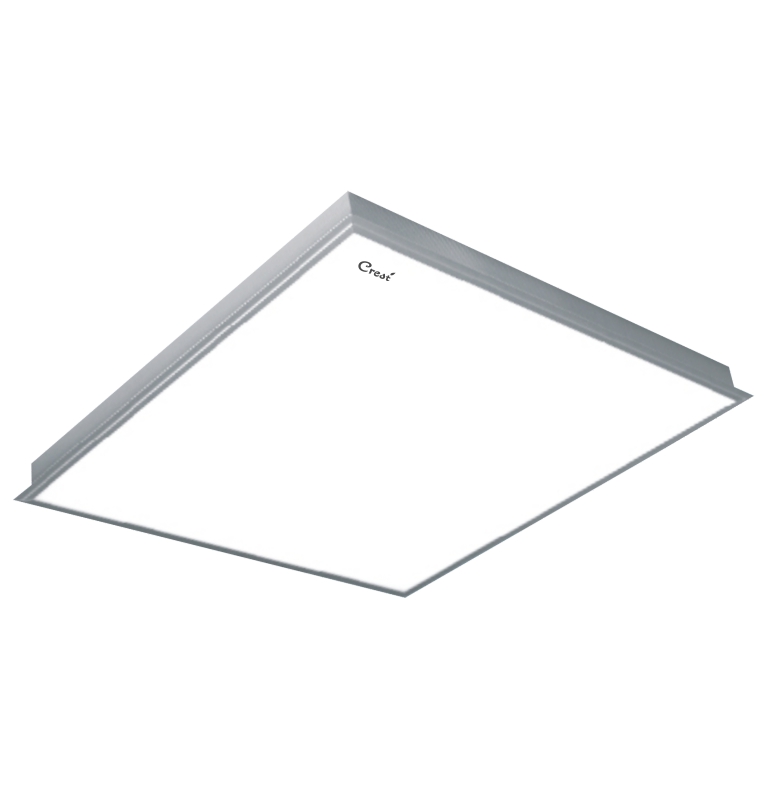
LED Slim Panel Light
LED LAMP APPLICATION CASES
The term LED means Light Emitting Diode, that is, in a free yield, light emitting diode. Light emitting diodes (LEDs) are light sources of suitable semiconductors, which, by applying a certain voltage value, have the ability to convert the electrical current passing through them into visible light.
That is, LEDs work quite differently from the well-known filament lamps (filament and halogen), discharge fluorescent lamps and discharge lamps.
In recent years, the LED technology has evolved overwhelmingly, provides great efficiency and light output and adequately covers all kinds of new requirements of both general and local lighting as well as car lighting as well as architectural lighting and street lighting (road lighting). The ideal prediction would be to replace the existing conventional LED lighting sources in the near future.
Key benefits
LEDs used as light sources offer many advantages, such as:
the small and compact size,
high luminous intensity,
very low power consumption (energy savings) given that they require 75% less energy,
safe operation (direct current of low voltage and voltage values)
instantaneous ignition (no warm-up required)
the full dimmable capability of 0-100%,
their ecological behavior (not including mercury and lead)
the emission of light free of IR or UV radiation,
heat-free operation,
non-electromagnetic wave operation,
the choice of color temperature,
the best color renderer (CRI) value,
directional light,
the exceptionally long service life (up to 50,000 hours),
the minimum maintenance cost (replacing a lamp every 11 - 13 years),
great mechanical flexibility in application,
the ability of interactive lighting applications with color and movement
reliable and high mechanical resistance to adverse operating conditions, and
the ability to replace any type of bulb in any luminaire without converting it
Applications
The use of LEDs is suitable for applications such as:
general and local indoor lighting,
the lights,
the emergence of architectural and decorative details,
traffic signaling,
orientation lighting in buildings,
escape route signage and
modern compact luminaires with intensity and color control
Technical requirements
The lamps LED, for the primers, require in the electrical circuit using suitable electronic system operation which must be matched to the electrical power ( W ) of the used lamp system.
The electronic LED lamp control systems - belonging to high-end devices - are the main advantages:
compatibility between a dimmer and sensor, resulting in a wide variety of applications under different lighting conditions,
security design, with the direct effect of fully operating a device for many solutions,
low power consumption thanks to their extremely high performance,
the small demands of the space they occupy
long life thanks to the monitoring system and intelligent control functions
the potential energy savings from the monitoring of energy consumption and control the dimming function ( dimming )
the ability to connect multiple units in parallel or in series with each other within the specified output area, but not on the secondary side,
the lengths allowed on the side of the secondary and
the ability to incorporate them into the luminaires
Control systems
Types of electronic LED bulb control systems that can be used in a lighting installation are classified in the following general categories, which will include the following:
power supplies without the display's brightness (non-dimmable),
power supplies with the possibility of adjustment of the illumination intensity ( dimmable ) and
aggregate devices functions ( all in one device).
Adapters (one dimmable )
The lamp power supplies LED without the display's brightness (non-dimmable) distinguished - from the side of the output - to:
stable voltage and
constant current.
These power supplies, depending on the purpose they serve, are available for different voltage and current values and are described
Power supplies (dimmable)
In fact, by dynamic lighting, we mean the ability to adjust the light intensity in electrical installation in absolute correspondence to the intended use, e.g. decorative applications, sophisticated RGB color controls, etc.
Achieving potential lighting is a function of using suitable devices that can be internal or external LED power supply adjustment systems
Internal integrated power supply systems, also known as dimmer power supplies, combine the power supply and thus the light intensity control of their LED units into one device, saving space and simple installation.
The external power supply systems which are characterized as controllers ( Drivers ) dimmer, connected between the power supply and controllers for adjusting the illumination intensity of the units LED, providing maximum flexibility in the choice of lighting applications.
Electronic systems
All LED elements require direct current to power them. The maximum current is determined for each specific LED element, and in this sequence, the resulting light output is also determined. At this point, it should be clarified that a lighting study data bulbs LED, not only required and only the determination of photometric and geometric parameters thereof. The appropriate power supply and the appropriate electronic components required to generate the required DC power must be selected so that the selected LED unit is fully utilized when used in a particular application.
In operation - so - of the electronic LED operating systems, and with the power input of the input side, the alternating voltage of the network is rectified to a constant voltage. This voltage is transformed into a high-frequency generator at a controlled voltage AC voltage which in turn decreases to a lower voltage to the output side of the system. This new voltage is rectified to continuous, and then additional recovery and filtering are led to the load, that is, the arrangement of the LED lamps.
Finally, in the loop formed through the control unit, there is feedback on the output side by adjusting the voltage produced or the current produced - depending on the mode of operation of the LED lamps, constant voltage, e.g. 24 V, or constant current value e.g. 350 mA - at the desired values, with corresponding and at the same time proportional frequency adjustment.